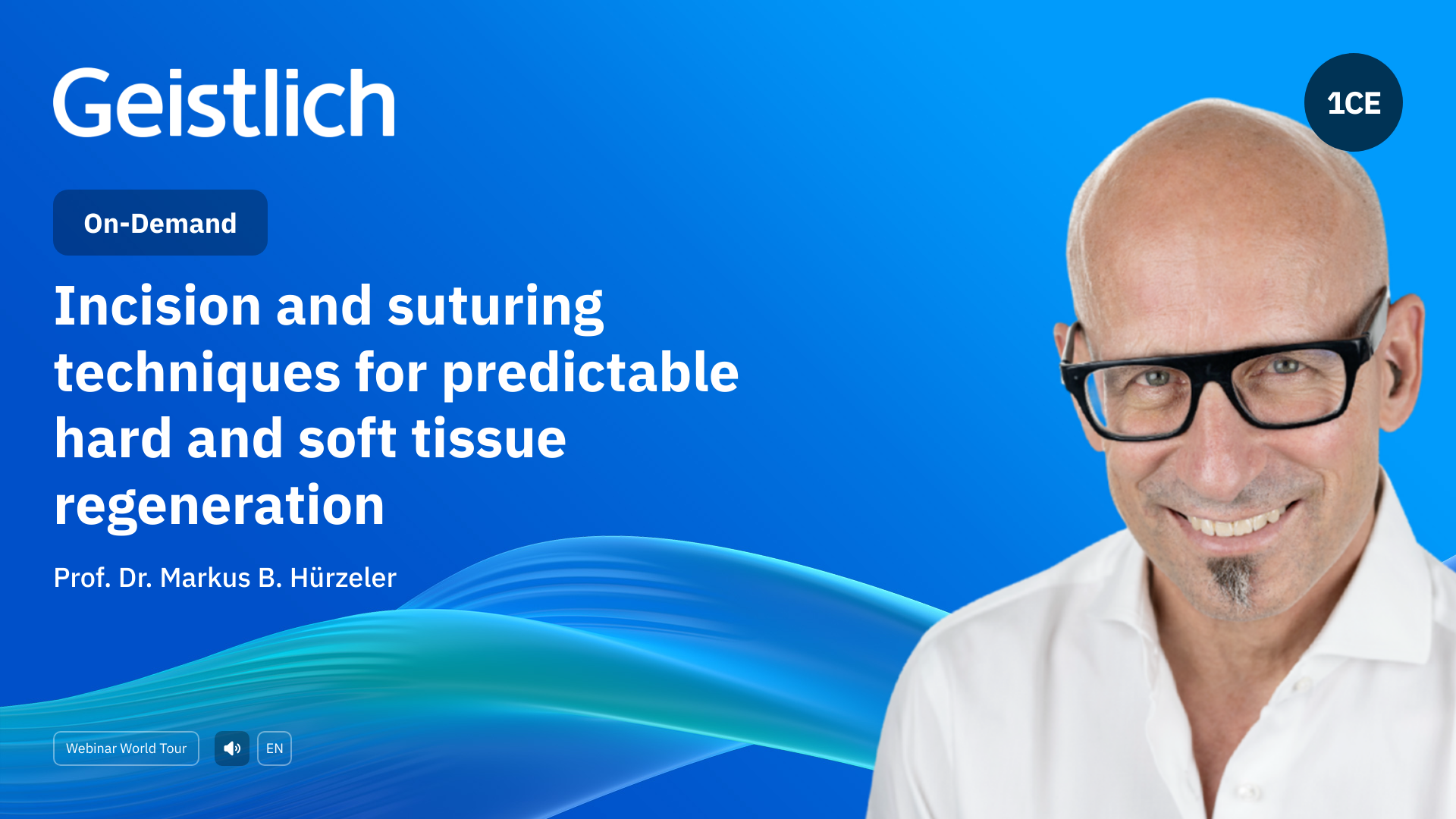
Incision and suturing techniques for predictable hard and soft tissue regeneration
Incision design in contemporary implantology has undergone substantial conceptual and technical evolution over the past decades. Whereas surgical approaches historically emphasised wide exposure and maximal visibility of the operative field, modern surgical concepts increasingly focus on minimising surgical trauma and postoperative morbidity. The long-standing paradigm that extensive incisions facilitate superior surgical outcomes is no longer supported. Instead, meticulous preoperative planning of incision design has become a critical determinant of clinical success.
Particular attention must be paid to anatomical regions with a high density of neural structures, as inappropriate incision placement may result in iatrogenic nerve injury and subsequent postoperative pain or sensory disturbances. Equally important is a detailed understanding of the vascular supply of the surgical site. The biological consequences of incisions placed through the interdental papilla between two implants differ fundamentally from those placed between two natural teeth, owing to significant differences in vascularization. These considerations necessitate revised surgical concepts when performing reconstructive procedures with grafting materials in interproximal areas between teeth or implants.
Reconstructive surgery inherently depends on the wound-healing capacity of the individual patient. However, contemporary surgical philosophy increasingly aims to reduce this dependency by optimizing surgical design and technique. Future developments in reconstructive implant surgery will therefore focus on procedures that promote stable wound closure and tissue regeneration while minimizing reliance on variable patient-specific healing potential.
A parallel evolution has occurred in suturing techniques. Over the last two decades, suturing has transitioned from a secondary procedural step to a critical component of the surgical intervention itself. Former practices—such as delegating wound closure to auxiliary personnel—are no longer acceptable within modern surgical standards. Precise suturing techniques and exact approximation of wound margins are essential prerequisites for predictable, reproducible, and biologically stable clinical outcomes.
This webinar reviews the evolution of incision and suturing techniques over the past 20 years, with particular emphasis on contemporary minimally invasive incision concepts that achieve comparable regenerative outcomes while significantly reducing postoperative morbidity. In addition, surgical strategies are presented that aim to enhance the predictability of hard and soft tissue regeneration by minimising dependence on individual wound-healing capacity.
Speakers
Prof. Dr. Markus B. Hürzeler
More courses with Prof. Dr. Markus B. HürzelerMarkus B. Hürzeler received his D.M.D. degree in 1984 from the University of Zürich, his certificate as specialist in Periodontics from the Swiss Society of Periodontology in 1989, the certificate in Prosthodontics from the German Society of Prosthodontics in 1991. Then, he spent two years at the University of the Houston, Texas, Dental Branch as a Visiting Associate Professor on the Department of Periodontology from 1991-1993. After returning to Freiburg, Germany he obtained in 1996 the Docent (PhD) degree from the Department of Prosthodontics at Albert-Ludwigs University in Freiburg Germany. He then moved to Munich, Germany, where he has been working ever since in private practice together with his partner Dr. Zuhr limiting his activity to periodontics and implant therapy. In 2002 he became Professor of Dentistry from the Medical Department of Albert-Ludwigs University in Freiburg Germany. In 2008, he founded the Huerzeler/Zuhr Education Center with his partner Dr. Zuhr in which they teach their concepts and philosophy in today’s dentistry. Since 1993 he is Clinical Associate Professor at the University of Texas, in Houston and since 1997, he is an Associate Professor at Albert-Ludwigs University in Freiburg Germany, Department of Preventive Dentistry and Periodontology.
He is an active member of the European Academy of Esthetic Dentistry (EAED). Dr. Hürzeler has produced more than 150 scientific publications within the field of implants, periodontology, and tissue regeneration and he lectures and gives courses regularly, both nationally and internationally, on topics related to periodontics and implant therapy. In 2012 he published with his partner Dr. Zuhr the worldwide known book: Plastic-Esthetic Periodontal and Implant Surgery – A Microsurgical Approach.